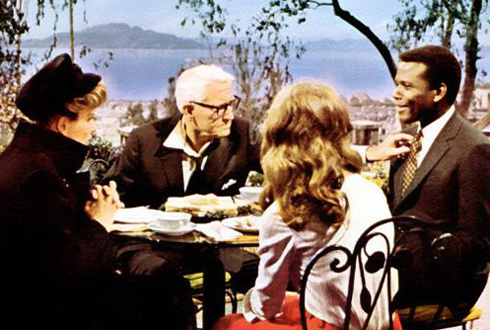
The 1967 film, Guess Who's Coming to Dinner?, confronts ideas of miscegenation in a divided United States. Joanna falls in love with Dr. Prentice in Hawaii and brings her black lover home to her parents who up until then seemed like liberal civil rights activists. At the time, interracial marriages were still illegal in some states. But were Joanna's parents racists or did they just have a problem with a black man marrying their daughter?
Racism is an interesting concept because it can take several forms. Some people think it's racist to draw differences between groups, others are bother by derogatory words or phrases, and some people aren't racist until their daughter is dating someone of a different race. In the film, Dr. Prentice is a charming, educated, and reasonable man. He might have very well been considered perfect by Joanna's parents had he been white. That's where racial differences become interesting, when people are willing to sacrifice substance to please visual preferences. Perhaps, Joanna's parents were simply worried about the future of John Prentice and Joanna because they would be discriminated against or perhaps it truly bothered them that their daughter was in love with someone who wasn't white.
In the article, "'My Daughter Married a Negro:' Interracial Relationships in the United States as Portrayed in Popular Media, 1950-1975," by Melissa Magnuson-Cannady (2005), analyzes the history of interracial marriages. As a member of an interracial marriage, she discusses how the various laws implemented against the practice prevented individuals who were in love from getting married. It is identical to the activism set forth by the gay rights movement today. Also, in the article "Guess Who's Been Coming to Dinner? Trends in Interracial Marriage over the 20th Century," by Roland G. Fryer Jr. levels of racism are outlined. He illustrates how many people embrace people of other races in work, school, even quasi-social environments but begin to feel uncomfortable when intimacy is introduced. He claims that intimacy is the most accurate indicator or racial tolerance.
Though I believe intimacy illustrates complete acceptance of race, I don't think it can be the sole indicator because of previous conventions set forth. If an individual was raised to only be around one particular race he or she might not be attracted to people of other races. Racism remains a flaw in human history and it sets society back by marginalizing relationships and potential. Love shouldn't be regulated by moronic ideologies like racism but love can't be the measure for whether or not different peoples are equal in society.
(Here Joanna's father finally expresses his acceptance of her relationship with Dr. Prentice. After he realized how much the couple loved one another he reanalyzed the situation and understood that as long as their love was true that they could be happy together. He however does express his fear of how society will react to their marriage.)


No comments:
Post a Comment